
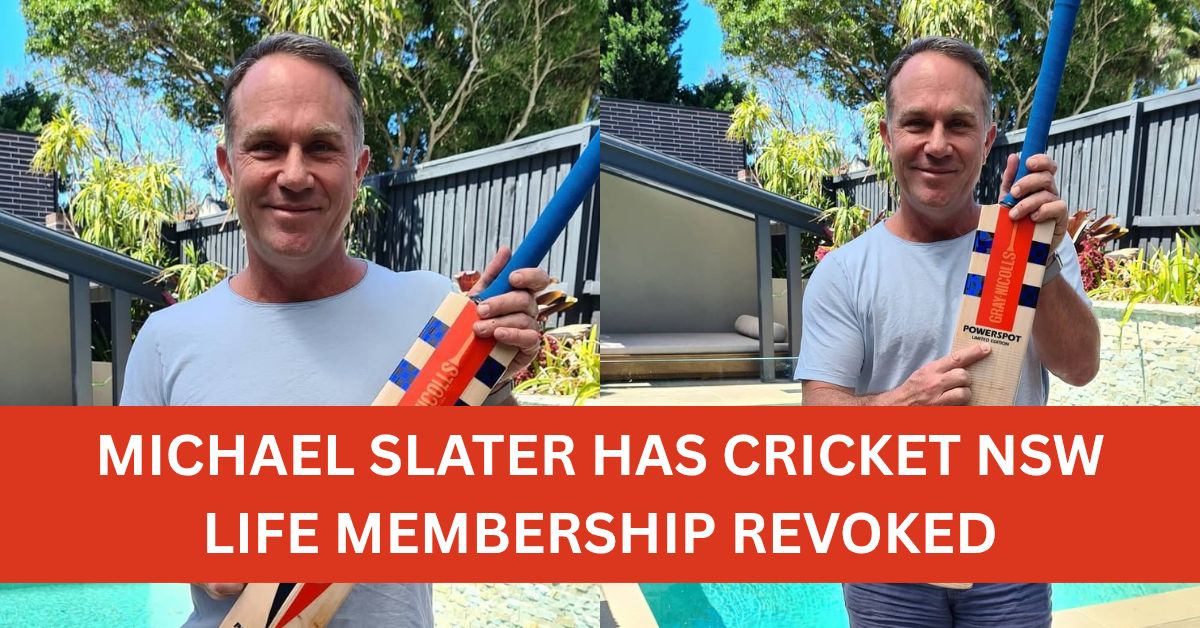
Former Australian Test opener Michael Slater has had his Cricket NSW life membership officially revoked, marking one of the most significant disciplinary actions taken by the organisation in recent years. The 55-year-old, once celebrated for his dynamic batting and passionate commentary career, is no longer listed as a life member after a vote was passed during Cricket NSW’s ordinary general meeting on Monday evening. The move comes in the wake of multiple domestic violence offences that have severely damaged his public standing and raised broader questions about accountability within sporting institutions.
Cricket NSW sources, speaking on the condition of anonymity due to the sensitivity of the matter, confirmed that delegates and members backed a board-proposed motion to strip Slater of the honorary title. Despite making a written submission defending his right to retain life membership, Slater was unable to convince the board, which ultimately voted to remove both his life membership and hall-of-fame status.
The decision closes a chapter on what had once been a celebrated cricketing legacy. Slater, inducted into the Cricket NSW Hall of Fame in 2015, previously enjoyed widespread admiration for a glittering career that spanned 74 Test matches, 42 ODIs and more than 200 first-class matches for NSW and Australia. His debut at Old Trafford in 1993 — the same Test in which Shane Warne delivered the “ball of the century” — remains etched in cricket history. Slater also forged one of Australia’s most consistent opening partnerships alongside Mark Taylor, who later became national captain.
But his achievements have been overshadowed by the escalating pattern of domestic violence allegations and convictions that have surfaced over the last decade. Slater’s downward spiral became publicly visible in 2022 when he was convicted of multiple domestic violence offences against women. Since 2016, five women in New South Wales have taken out protection orders against him, a detail that played a key role in shaping Cricket NSW’s position.
In Queensland earlier this year, Slater faced the Maroochydore District Court where he pleaded guilty to seven charges, including two counts of choking a woman. The seriousness of the offences led to stern words from Judge Glen Cash, who highlighted Slater’s long-term struggle with alcohol dependency as a central factor contributing to his behaviour.
“It’s obvious, Mr Slater, that you are an alcoholic,” Judge Cash said during sentencing.
“Regrettably, your alcoholism has brought an end to your profession. Your rehabilitation will not be easy — alcoholism is part of your make-up.”
Those words reflected a reality that has increasingly defined Slater’s post-cricket life. After being dropped from the Australian Test side during the 2001 Ashes tour, Slater later reinvented himself as a high-profile commentator in Australia and the UK. He joined Channel Seven when the network secured free-to-air broadcast rights in 2018, but his contract was not renewed in 2021 — long before the full extent of his legal troubles became public.
Sources also confirmed that Slater’s hall of fame status had already been rescinded before this week’s meeting, meaning Monday’s vote formally removed the final remaining honour held by the former Test opener. Cricket NSW’s list of life members — which includes icons such as Mark Taylor, Glenn McGrath, Belinda Clark, Brett Lee, Lisa Sthalekar, and the Waugh brothers — no longer features the once-popular batter.
For many within the cricketing community, the decision marks a sad but necessary step. Organisations across Australia have increasingly come under public pressure to respond decisively to allegations of domestic violence, especially involving high-profile sports figures. Cricket NSW’s move is being seen as part of a broader shift towards stronger accountability and maintaining integrity within the sport.
Slater’s written appeal to keep his life membership — the contents of which have not been publicly released — failed to sway the board. Instead, his record of offences, along with the severity of the Queensland case, formed the basis of a unanimous decision to remove him from the organisation’s highest honours.
What remains now is a complex legacy: a player once adored for his energy, passion, and explosive batting at the top of the order, now defined largely by legal issues, personal struggles, and a fall from grace that continues to reverberate across Australian cricket.
Cricket NSW has not issued a public statement beyond internal confirmation of the vote, and Slater himself has declined to comment on the revocation. However, with his life membership and hall-of-fame recognition now officially removed, the consequences of his actions have become both permanent and historic — a stark reminder of the standards sporting organisations are increasingly being held to.